Professional Ecommerce Website: The Definitive Guide to Growing Your Online Store Beyond Facebook
Discover how a professional ecommerce website can transform your Facebook-based business with branded storefronts, easy checkout, product management, and better customer trust
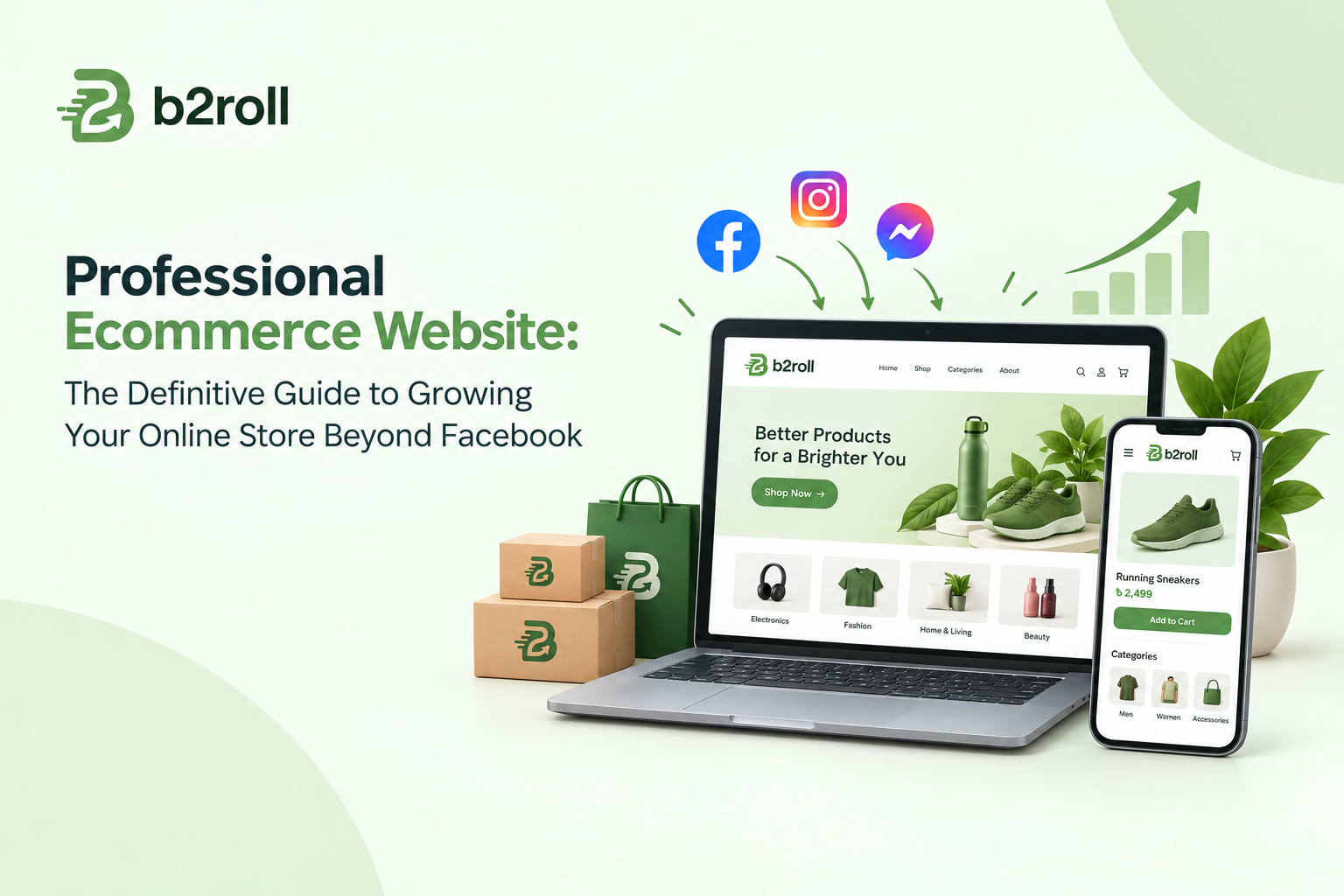
You built your business on Facebook, Instagram, and Messenger — and that was the right place to start. It's where your customers already are, and it costs nothing to set up a page and start posting. But there's a catch: the moment your entire business lives inside someone else's platform, you're one algorithm change away from losing the audience you worked so hard to build.
This guide walks through why a professional ecommerce website changes that equation — how it builds trust, organizes your products, simplifies ordering, and hands you real control over how your business grows.
Key Takeaways
● A professional ecommerce website gives your business a dedicated digital storefront instead of relying entirely on social media profiles.
● Customer trust improves when shoppers see your own domain, branded design, organized products, and a structured checkout.
● Product organization gets easier when customers can browse categories, products, prices, and offers in one place, instead of scrolling through old posts.
● Online ordering becomes far more structured when customers check out through a dedicated flow instead of typing out orders in DMs.
● Business control improves when your store, products, orders, customers, and operations all live on one platform.
● B2roll helps Bangladeshi merchants launch branded ecommerce websites with custom domains, courier integrations, COD management, SMS tracking, and store management tools.
● Social media and a website work best together — Facebook and Instagram bring the customers in, while your website is the destination you actually own.
What Is a Professional Ecommerce Website?
A professional ecommerce website is a branded online store where customers can discover your products, check details, place orders, and interact with your business through a storefront that's entirely yours.
The difference from a Facebook page is fundamental: your website is built around your brand, not someone else's platform. You get your own domain, your own logo and colors, a real product catalog, and a checkout experience that's designed the way you want it — not the way a social feed dictates.
Think about the alternative. Right now, if a customer wants to find a specific product, you're probably telling them to "scroll down, it's a few posts back." With a website, you send them straight to a product page — price, description, images, and an "order now" button, all in one place.
And to be clear: going professional doesn't mean giving up Facebook. The two aren't in competition. Facebook and Instagram are excellent at getting people to notice you; your website is where they actually buy.
Why a Professional Ecommerce Website Matters for Growth
Social media is genuinely great at reaching new customers. But it wasn't built to give merchants full control over the shopping experience — algorithms shift, feeds get crowded, and ordering through comments and DMs doesn't scale.
Here's a familiar scenario: a customer spots your product on Facebook today, loves it, gets distracted — and by tomorrow, three new posts have buried it. Now they can't find it again, and neither can you point them to it easily.
A website solves this by giving your business a fixed address. No matter what's happening in your social feed that week, your brand and your catalog are exactly where you left them.
This is where B2roll comes in. It's built specifically for Bangladeshi merchants who are already selling on Facebook and want to add a website to the mix — combining a branded storefront with order management, courier integration, SMS updates, and delivery tracking in one place.
Facebook Selling vs. Having Your Own Ecommerce Website
Facebook and a website aren't solving the same problem. Facebook is built for discovery — getting people to notice you. A website is built for the actual transaction — turning that attention into a completed, trackable order.
Business Area
Facebook / Social Media Only
Professional Ecommerce Website
Brand presentation
Dependent on platform layout
Your own branded storefront
Product organization
Posts, albums, messages
Dedicated product catalog
Ordering
Handled through comments or DMs
Structured online checkout
Customer journey
Feed-based
Store-based
Domain ownership
No dedicated store domain
Custom domain available
Order management
Often manual
Centralized order workflow
Courier operations
Separate and manual
Can be integrated
Customer tracking
Requires back-and-forth messages
Dedicated tracking experience
Business control
More platform-dependent
More control over the store experience
None of this means dropping social media. The winning combination is simple: social media for discovery, your website for conversion and ownership.
How a Website Builds Customer Trust
Trust is earned in seconds online, and a website earns it in ways a social profile can't.
Your own domain makes your business look established. When a customer sees yourbrand.com instead of just a profile page, it signals you're a real, permanent business — not a page that could disappear tomorrow.
Picture a fashion brand promoting a product on Facebook, then sending shoppers to their own website to browse the full collection — no more "which sizes are available?" messages, just a clear catalog they can explore themselves.
Consistent branding does a lot of the heavy lifting here. B2roll supports custom domains and SSL out of the box, so your storefront looks like your brand — not a generic marketplace listing. Stores can also be customized with your own logos, color palettes, fonts, and favicons across B2roll's theme system.
At the end of the day, trust grows when customers instantly understand who you are, what you sell, and how to order from you.
How a Website Organizes Products Better
A website turns your inventory into a real, browsable catalog — no more asking customers to dig through old posts.
This matters more as you grow. Ten products are manageable on Facebook. A few hundred products are not — customers will simply give up looking.
A clothing store, for instance, can organize everything into Men, Women, New Arrivals, Best Sellers, and Sale — letting customers go straight to what they actually want instead of hunting for it.
It also means product information finally has a consistent format: images, prices, descriptions, variations, and stock status, presented the same way every time. B2roll supports unlimited products across its plans, bringing products, orders, returns, coupons, analytics, and staff management into a single dashboard.
How a Website Makes Online Ordering Easier
Anyone who's sold on Facebook knows the drill: "Price?", "Is this available?", "How do I order?", "Where's my order?" It works fine at low volume — and becomes chaos the moment your business grows.
Behind the scenes, merchants are often manually pulling a customer's name, phone number, address, product choice, and payment details out of Messenger just to create a courier order. It's slow, error-prone, and doesn't scale.
A proper checkout fixes this by collecting everything up front, in a consistent format, every single time — less back-and-forth for the customer, less manual work for you.
B2roll handles this with automated COD order management, support for COD and bKash/Nagad payments, and built-in coupon and discount handling right in the cart. It also connects orders directly to courier operations, with native integrations for Pathao, Steadfast, RedX, and CarryBee — so the whole fulfillment process happens inside one dashboard.
In short: a website turns ordering from a conversation into a repeatable process.
Why Businesses Shouldn't Rely on Facebook Alone
Social media should be your customer-acquisition engine — not the entire foundation your business stands on.
Facebook and Instagram are fantastic for reaching audiences, showcasing products, and staying in touch with customers. But you don't control the platform itself — algorithm changes and feed shifts can affect how easily people find you, with zero warning.
Then there's the operational side. Orders scattered across Facebook and Instagram DMs mean there's no single source of truth — and returns or refunds become genuinely hard to track down.
And structurally, social media just isn't built for product discovery the way a catalog is. A website lets customers browse intentionally, on their own time — instead of waiting for the right post to resurface in their feed.
Your social audience is valuable. Your website is where you give them somewhere to actually belong.
What Business Operations a Branded Website Can Improve
A branded website doesn't just look better — it tightens up how your business actually runs.
Order management becomes far simpler with one central dashboard. B2roll's dashboard brings products, orders, returns, coupons, analytics, and staff management into a single view.
Courier integration cuts out repetitive data entry — B2roll's workflow lets you create a store, connect a domain, link a courier API, and start processing orders automatically.
Customer communication gets proactive instead of reactive. B2roll's SMS automation sends updates at order confirmation, shipping, and out-for-delivery stages — so customers stop messaging to ask "where's my package?"
Order tracking becomes part of the branded experience itself, with a five-stage timeline — Ordered → Confirmed → Shipped → Out for Delivery → Delivered — synced automatically with courier status.
How B2roll Helps You Launch Your Own Online Store
B2roll gives Bangladeshi merchants everything needed to launch a branded ecommerce website — custom domains, product management, automated COD workflows, courier integrations, SMS tracking, and centralized operations, all in one platform.
Getting started is straightforward: pick from 10 premium layouts and customize them with your logo, color palette, fonts, and favicon. Connect a custom domain with SSL — no technical setup required — or start immediately on a free {store}.b2roll.com subdomain.
From there, plug in delivery: Pathao, Steadfast, RedX, and CarryBee are all natively supported, so your store isn't just a catalog — it's a fully operational business.
[ B2roll reports 1,240+ stores launched and 2.3 million orders processed, with a stated 99.98% uptime over the last 12 months. (Source: B2roll, 2026) ]
If you want to see it for yourself, B2roll's website has full details on features, templates, delivery integrations, pricing, and setup.
What to Do Next If You Sell on Facebook
Ready to build your own destination while keeping Facebook as your discovery channel? Here's the path:
Pick your brand name and domain. Keep it memorable and consistent with your existing brand identity.
Organize your catalog before you launch. Get your product names, prices, images, descriptions, and categories ready ahead of time.
Map out the customer journey:
○ Discover — Customer sees your product on Facebook, Instagram, or elsewhere.
○ Visit — Customer clicks through to your branded website.
○ Browse — Customer explores your products and categories.
○ Order — Customer completes checkout.
○ Track — Customer gets delivery updates and tracks their order.
○ Return — Customer comes back to your website for their next purchase.
Gradually shift operations away from manual messaging. B2roll's workflow connects store creation, custom domains, courier APIs, automated orders, tracking, and SMS notifications — so you're not doing it all by hand.
Frequently Asked Questions
Do I need to shut down my Facebook page to launch a website?
No. Facebook and Instagram remain great for discovery and reaching new customers. Your website simply becomes the place where those customers browse, check out, and come back to — the two work side by side, not against each other.
Is a professional ecommerce website expensive to set up?
Not necessarily. Platforms like B2roll offer a free {store}.b2roll.com subdomain to start, along with a 30-day free trial and no credit card required, so you can launch before committing to a custom domain or paid plan.
Will my customers still be able to order via Messenger if I have a website? Yes, if you want to keep that option open. Most merchants gradually shift order volume toward the website's checkout because it's faster and more organized, but there's no rule that says you have to close off Messenger orders entirely.
How does a website help with delivery and courier management?
A platform like B2roll connects your store directly to courier services such as Pathao, Steadfast, RedX, and CarryBee, so orders can move from "Confirmed" to "Delivered" without you manually coordinating with couriers over the phone or in separate apps.
Can I keep Cash on Delivery (COD) if I move to a website?
Yes. B2roll's checkout supports COD alongside bKash and Nagad, so you're not forced to give up the payment methods your customers already prefer.
How long does it take to launch a store?
It depends on how ready your product catalog is, but the core steps — picking a theme, adding products, connecting a domain, and linking a courier — are designed to be done without needing technical or developer help.
Will I lose my existing Facebook followers and reviews?
No — your Facebook page, followers, and reviews stay exactly as they are. A website adds a second destination; it doesn't replace or migrate your social media presence.
‘‘ Your Facebook page can start the conversation. Your own website can build the business. ’’